
There is not much suspense in a sunscreen review. I have worn La Roche-Posay Anthelios Mineral Light Fluid Sunscreen on my face and neck every morning since the first week of February, and my honest summary is that nothing happened. No line lifted. No spot faded. Nobody asked what I was doing differently. That is what I wanted from it, and it is also where the arguing starts, because a product that produces no visible result is a hard thing to feel good about.
I am 59. I retired after 27 years as the office manager of a dental practice in Spokane, Washington, and I started paying attention to my skin in January after a close-up photo at my sister Patty's birthday dinner showed my dry cheeks and the age spot on my left cheek. The spot was the thing that bothered me most. Sunscreen was the thing I had been skipping, mostly because every bottle I had tried stung my eyes and I could not get past it. So I bought a bottle of La Roche-Posay Anthelios Mineral, started it the first week of February, and have not missed a morning since. Here is what nine months of that looks like, including the parts the listing does not put on the front of the box.
One thing before we go further. This is not a skin treatment and I am not going to describe it as one. It is a sunscreen. Anything that looks like a skin condition is a dermatologist's call, not a review's.
The Quick Verdict
The first sunscreen I have worn every single day without my eyes stinging. You pay for that in a faint cast and a small bottle.
Amazon Check Today's Price →Why I stopped looking for a different sunscreen
SPF 50, 100% mineral with zinc oxide and titanium dioxide, unscented, and water resistant for 40 minutes. It goes on my face and neck, and then I forget about it.
Amazon Check Today's Price on Amazon →What Nobody Tells You About a Mineral Sunscreen
The white cast is the complaint in every mineral sunscreen review, and it is a real one. What nobody explains is that at least half the cast is a technique problem rather than a formula problem. If I dot this on in small sections and work each section until I cannot see it, the faint cast is gone in about two minutes and what is left is my face. If I squeeze a full line onto my fingers and smear it on the way I used to smear a cream, I look like I have been dusted with flour.
Zinc oxide and titanium dioxide are what makes it white. That is not a flaw in the formula, it is the formula. The minerals sit on the surface and reflect light, which is how the protection works. A chemical sunscreen goes on clear because it soaks into the skin, and that is also why my old one found its way into my eyes every time I sweated. The clear finish and the stinging came from the same place.
So the cast and the eye comfort come from the same ingredients, and you do not get one without the other at this strength. Once I understood that, I stopped being annoyed by the cast and started being careful with the application. That is the trade the La Roche-Posay is offering, and it is worth saying out loud before you buy it.
One more thing that does not make it into most reviews. The label says water resistant for 40 minutes, and 40 minutes is a limit, not a promise. On a long summer afternoon outside I am supposed to reapply, and reapplying over a face that already has moisturizer and vitamin C on it is not the same smooth experience as the first application. It works, but it is a second shake and a second two minutes. I plan around it rather than fight it.
How I Apply It, and Why the Method Matters More Than the Formula
Shake the bottle. This is not a suggestion. It is a fluid, which is what the label calls it, and it separates. If I forget the shake I get a thin watery squirt and then a thick one, and the thick one is where the cast comes from.
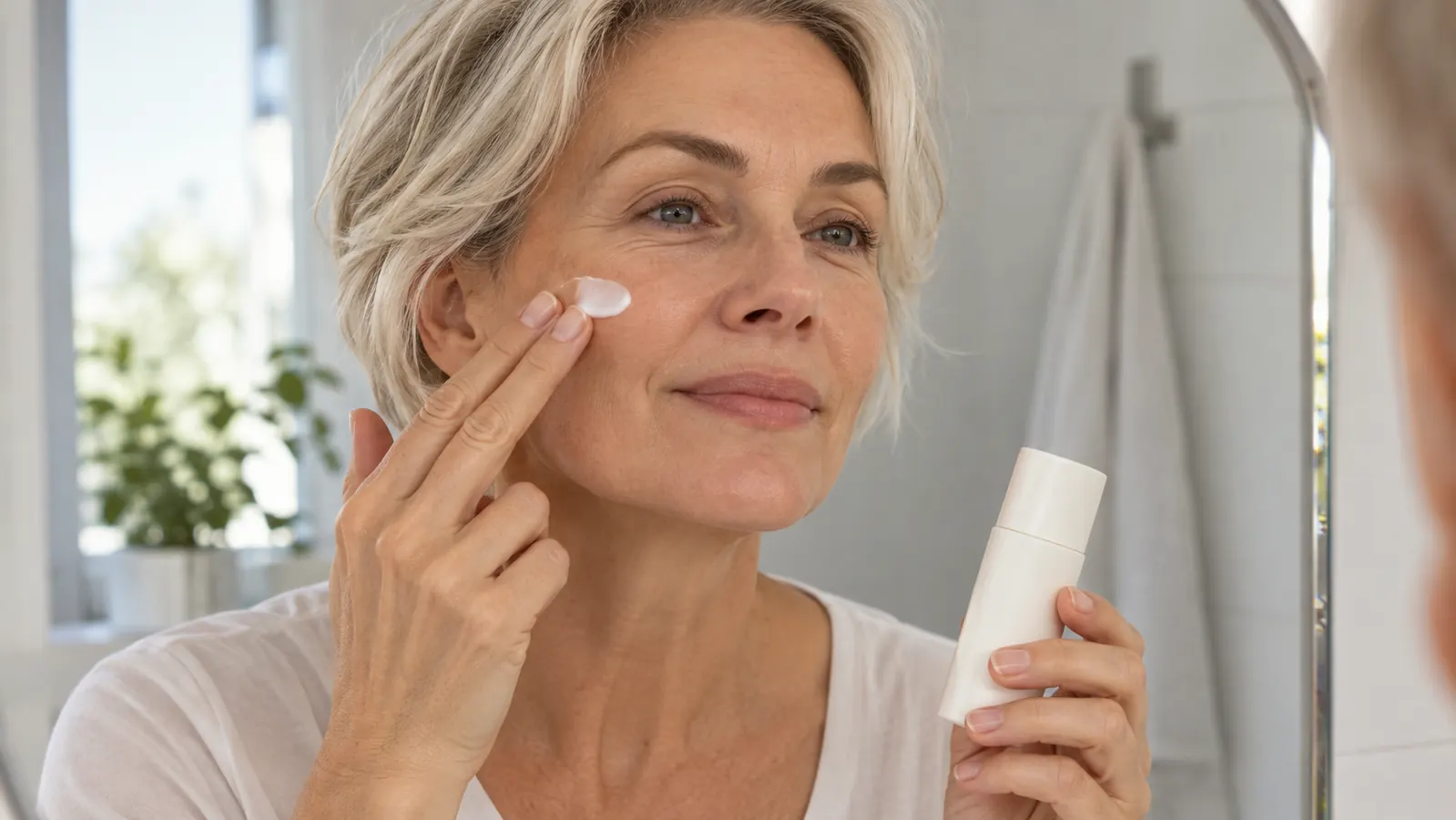
I do five small sections. Left cheek, right cheek, forehead, nose and chin, then my neck. About a fingertip of product for the face and another for the neck, dotting rather than smearing, working each section until it disappears. Then I go back around the outside of my eyes, because that is where it collects in the fine lines if I stop too early.
Then I wait two minutes. I use the time to put my shoes on and let the dog out. If I walk out the door immediately after applying, my sunglasses slide down the bridge of my nose and the phone against my cheek leaves a mark. Two minutes is the whole difference between a product I like and a product I would have quit.
That is the honest core of this review. The La Roche-Posay is not easier to apply than a chemical sunscreen. It is slower. I decided the slowness was worth it, because the alternative for me was not wearing sunscreen at all.
The Two Things That Actually Changed
Something visible did not change. Two things did. The first is that I wear sunscreen now. The old bottle, whose brand I could not tell you today, went on my face about four times a summer and stung my eyes every time I sweated, so I had quietly stopped by mid July without ever deciding to. I have worn the La Roche-Posay every single morning for nine months, including the cloudy ones in February, because it does not sting. That is a behavior change, not a skin change, and I think it is the more important one.
The second is that I stopped thinking about it. It is the last step of my morning now. Cleanser, the vitamin C, the eye cream, the moisturizer, then the sunscreen, then my walk. Nine months in, it is a habit rather than a decision I make. For a sunscreen, that is the entire game. A sunscreen you own is worth less than a sunscreen you use.
There is a smaller thing too. My face does not feel tight by the afternoon anymore. I cannot credit the sunscreen for that, because the Olay underneath is what fixed the tightness, and I would be lying if I gave credit to the layer that sits on top. It is a layer. It does its layer's job, and I try to keep the credit where it belongs.
The Bottle Is the Real Complaint
The bottle is 1.7 ounces, and it goes faster than I expected. Face and neck every morning takes more product than people think, and it takes more than the back of my hand ever got, which is how I used to apply sunscreen on the rare days I applied it at all.
It also costs more than the drugstore sunscreen I used to buy and not wear. I want to be straight about that trade, because it is the thing I would want to know. I am not saving anything. I am spending more on a bottle I actually use than I was spending on a bottle that sat in the cabinet until it went bad. It took me a while to be comfortable with that arithmetic, and I am still not thrilled about it. But a sunscreen you wear is not comparable to a sunscreen you own.
The tip is narrow, which is good for controlling how much comes out and bad at the end. When the bottle is nearly finished I have to stand it upside down and shake it and I still leave some in the bottom that I cannot reach. At the current price that bothers me more than it should, and I know it.
And the last thing, which is minor but true. The bottle is small enough that it reads as a face product rather than a body product, and it is one. The label says face and neck. Do not buy it planning to cover your arms and shoulders on a beach vacation unless you have thought through the arithmetic first.
The Finish, Under Makeup and in August
On its own the finish is matte. Not chalky, not powdery, just flat. My cheeks are dry and matte is not usually a word I want attached to my face, but because there is cream underneath it, it reads as normal skin rather than as a mask. In July and August I use less of the Olay underneath because it feels heavy, and then the sunscreen leans drier on its own. That is a routine problem rather than a sunscreen problem, but it is worth knowing if your skin is dry like mine.
I do not wear foundation most days. On the days I do, it goes on over this without pilling, which surprised me. The trick is the two minutes again. Thirty seconds after the sunscreen, foundation drags and patches over the top. Give it two minutes and it sits.
It is also unscented, which matters to me more than I expected. The old sunscreen smelled like a pool toy and I could taste it in the back of my throat for an hour afterward. This one has nothing to taste.
Nine months of daily use and the only thing that changed is that I am wearing sunscreen. For a sunscreen that is the whole point, and it is also the hardest thing to sell anyone on.

What It Will Not Do
This is the section I would want to read before buying. The La Roche-Posay will not fade the age spot on my left cheek. The vitamin C serum is what I use for the spot and it has done a modest job at best. It will not plump the dry crepey skin under my eyes. That is the eye cream. It will not smooth texture. That is the retinol at night, and it took about three months to do anything at all. The sunscreen does one job, it does that job well, and if you are buying it hoping for a second job you will be disappointed by week three.
I also want to say the quiet part. A sunscreen's benefit is invisible by design. You do not see it working. You see it in ten years, or you do not, and either way you cannot prove in a mirror that it was the sunscreen. I have made my peace with that, but if you need a product to give you visible feedback in order to keep using it, this will be hard to stick with. This has to become boring in order to work.
There is a version of this review that promises you something. I have read plenty of those. I am not going to write one, partly because it would not be true and partly because I would be the one left with the bottle on the shelf, knowing better.
What I Liked
- Does not sting my eyes, which is the only reason I wear sunscreen daily now
- 100% mineral, SPF 50, with zinc oxide and titanium dioxide
- Unscented, so there is no smell to taste
- Matte finish that sits under foundation without pilling
- Water resistant for 40 minutes per the label
- My dry, mildly sensitive cheeks have not reacted to it once
Where It Falls Short
- A faint cast for a minute or two if I rush the application
- 1.7 ounces goes fast when you use it on face and neck daily
- Costs more than drugstore sunscreen, and I notice
- The narrow tip leaves product in the bottom of the bottle
- Leans dry in summer when I cut back on moisturizer
- Produces no visible result, which is the point and still hard to feel good about
How It Sits With the Rest of My Routine
Morning order, since people ask. Cleanser first. Then the vitamin C on clean skin, and I wait about a minute because it is slightly tacky if I rush it. Then the eye cream, a pea size for both eyes, patted with the ring finger. Then the moisturizer on face and neck. Then the sunscreen, last, always last, because it is the layer that has to sit on top of everything else.
The one thing I would tell you is not to put the sunscreen on before the moisturizer and expect the same finish. The cream underneath is what keeps it from reading flat on dry skin. I did it out of order once by accident and spent the whole morning looking like I had been skiing.
At night the sunscreen does not appear. Cleanser, the retinol on retinol nights, wait for it to absorb, eye cream, moisturizer. If you take one thing from this, take that. Sunscreen belongs in the morning, retinol belongs at night, and the two do not need to meet.
Three Things I Would Change
A larger bottle. A tip that lets me get the last of it out. And a line on the front of the box that says plainly that a mineral sunscreen at SPF 50 will leave some cast if you rush it, so the first honest thing a buyer reads is not a review from a stranger on the internet. The formula I would not touch. Whatever they did to keep it out of my eyes, they should keep doing.
Who This Is For
Women roughly my age with dry, mildly sensitive skin who have quit every previous sunscreen because their eyes watered. Anyone who has tried a chemical sunscreen and had it sting, or had it slide into their eyes twenty minutes into a walk. Anyone who wants mineral, unscented and SPF 50 in one bottle and can live with a matte finish and a slow application. If you already wear a sunscreen daily and it is not bothering you, I would not necessarily change. The La Roche-Posay is for the person who is not wearing any.
Who Should Skip It
Skip it if you want a completely clear finish. A 100% mineral sunscreen at this strength with this much zinc oxide is going to show something, and on skin deeper than mine it will show more than the faint cast I get. I am fair skinned and I can only honestly tell you what it looks like on me. If a visible cast for a couple of minutes would make you stop using it, buy a chemical formula instead and accept the trade on the other end of it.
Skip it if you want visible anti-aging results from a single product. Skip it if you will not shake the bottle and spend two minutes on the application. Skip it if the cost means you would ration it, because a sunscreen applied sparingly is not doing the thing you bought it for. And skip it if you are looking for something to fade a spot or plump a line. That is a different product and a different conversation.
One job, done every morning since February
SPF 50, 100% mineral, unscented, water resistant for 40 minutes, 1.7 ounces for face and neck. If your eyes have quit on every other sunscreen, this is where I would start.
Amazon Check Today's Price on Amazon →