
The photo from my sister Patty's birthday dinner in January was the first honest look I had taken at my own face in years. Not a mirror at six in the morning, when nobody is at their best. A phone camera, close up, in a restaurant, with everybody smiling. My cheeks looked dry and a little crepey, the lines around my mouth were deeper than I had remembered, and the age spot on my left cheek sat right in the middle of the frame. I am 59. I retired after 27 years as the office manager of a dental practice in Spokane, and I am not a person who chases cures. But I sat in the car in the driveway for a minute before I went into the house, and then I went inside and started reading ingredient labels.
Here is the short version. The retinol I chose was CeraVe Resurfacing Retinol Serum, and I started it the first week of March. Retinol is the ingredient everyone points at, and it is also the one that frightens women my age. The stories are all peeling and redness and giving up. My skin is fair, my cheeks are dry, I am mildly sensitive, and I have no patience for anything that stings. So I did it slowly. This is the order I did it in, and the mistakes I nearly made along the way.
The retinol I started at 59, after four weeks of reading labels
CeraVe Resurfacing Retinol Serum: encapsulated retinol, niacinamide, licorice root extract and three ceramides, fragrance free, one ounce. It is the only retinol I have ever used, so all I can tell you is what it did on my face.
Amazon Check Today's Price on Amazon →Why Starting At 59 Is Different From Starting At 35
I am not a dermatologist and this is not medical advice, so take it as one woman's observation. Everything I read said the same thing in different words: after menopause, skin gets thinner, drier, and slower to bounce back. My own face agrees. The cheeks that were normal at 45 are dry now. A product that a 35-year-old can put on five nights a week is a different proposition on skin that is already short on moisture and takes longer to recover from anything.
That is why the single most useful thing I did was slow down. Not the product. The pace. Two nights a week sounded almost pointless to me in March, and by June it was the reason I was still using it at all. If you take one thing off this page, take the schedule and throw away the rest.
And one more thing about being this age. My skin does not forgive a rushed week the way it did at 40. If I use something new too often, or skip the moisturizer because it is August and I am hot, I see it in the mirror for four days. That is not a reason to skip the retinol. It is a reason to be deliberate about it, and to keep the rest of the routine boring.
The Five Steps, In the Order I Actually Did Them
Step 1: Fix the boring parts first, before you touch a retinol
Before I bought a retinol I spent four weeks on the unglamorous things. The first week of February I started two products: a 100 percent mineral sunscreen, SPF 50, that goes on every single morning including the cloudy ones, and a moisturizer I use morning and night on my face and neck. That is the entire list. No acids, no scrubs, no brushes, no ten step anything.
The reason is not complicated. Retinol makes skin more sensitive to the sun, and sunscreen is the step that decides whether any of the rest of it is worth doing. If you start a retinol in March and you are still only wearing sunscreen in July, you are working against yourself and you will blame the retinol. The second reason is buffer. When my cheeks already felt comfortable and cared for, a thin layer of something new on top was a small event. On tight, dry, angry skin it would have been a crisis.
Step 2: Buy a gentle, encapsulated retinol and read the whole label
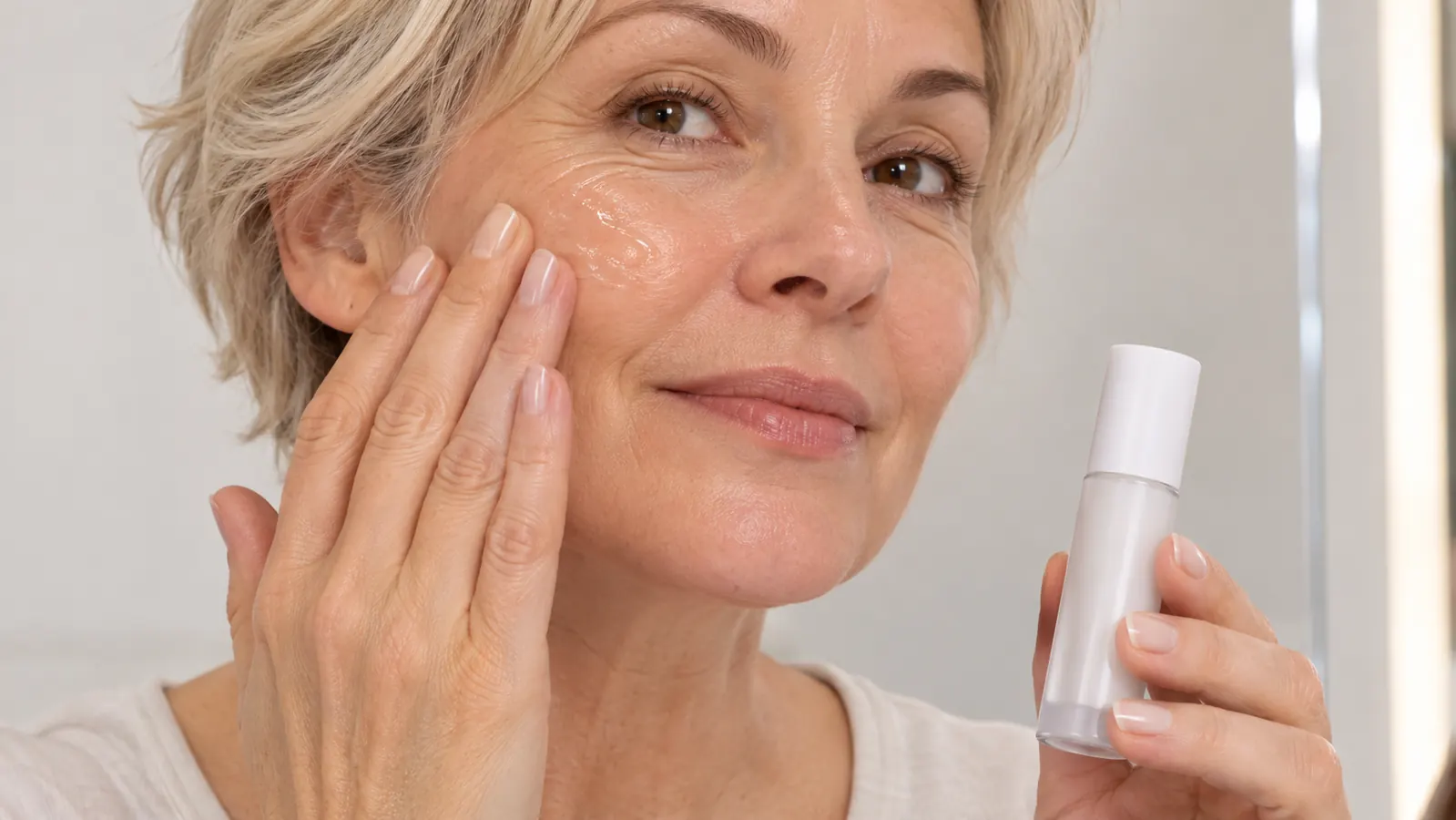
CeraVe Resurfacing Retinol Serum is what I bought, one ounce, and I read the listing three times before I ordered. What mattered to me: the retinol is encapsulated, which means it is released gradually instead of all at once. It also has niacinamide, licorice root extract and three ceramides. It is fragrance free and non-comedogenic, and it is a light gel serum rather than a cream. For skin like mine the ceramides are the part I care about most, because they are what dry cheeks are short on.
One thing you should know before you buy it. CeraVe markets this serum for post-acne marks and pores. I have never had acne in my life. I bought it for texture, because the skin on my cheeks had started to feel rough and thin, and I would rather tell you that plainly than pretend the marketing was written for me. A product can still be a reasonable choice when the label is aimed at somebody else. It just means you should set your expectations from the ingredient list and not from the front of the box.
What sold me was the ceramide part, honestly. Three ceramides, named on the label, in a product whose whole job is to speed up how fast the top layer of your skin turns over. A 20-year-old does not need that support. I do. When your skin is thin and dry and 59 years old, a retinol with nothing underneath it to hold the barrier up is the same story as the people who peel for a month and swear off the ingredient forever.
What I did not buy matters just as much. I did not buy the strongest thing on the shelf. I did not buy two retinols to compare. I did not buy an exfoliant to go with it, because a retinol and an acid in the same week is how people end up with a red face and a story about how retinol wrecked their skin. One new thing at a time. That has been my rule all year, and it is the only reason I can tell you what did what.
Step 3: Two nights a week. That is the entire schedule.
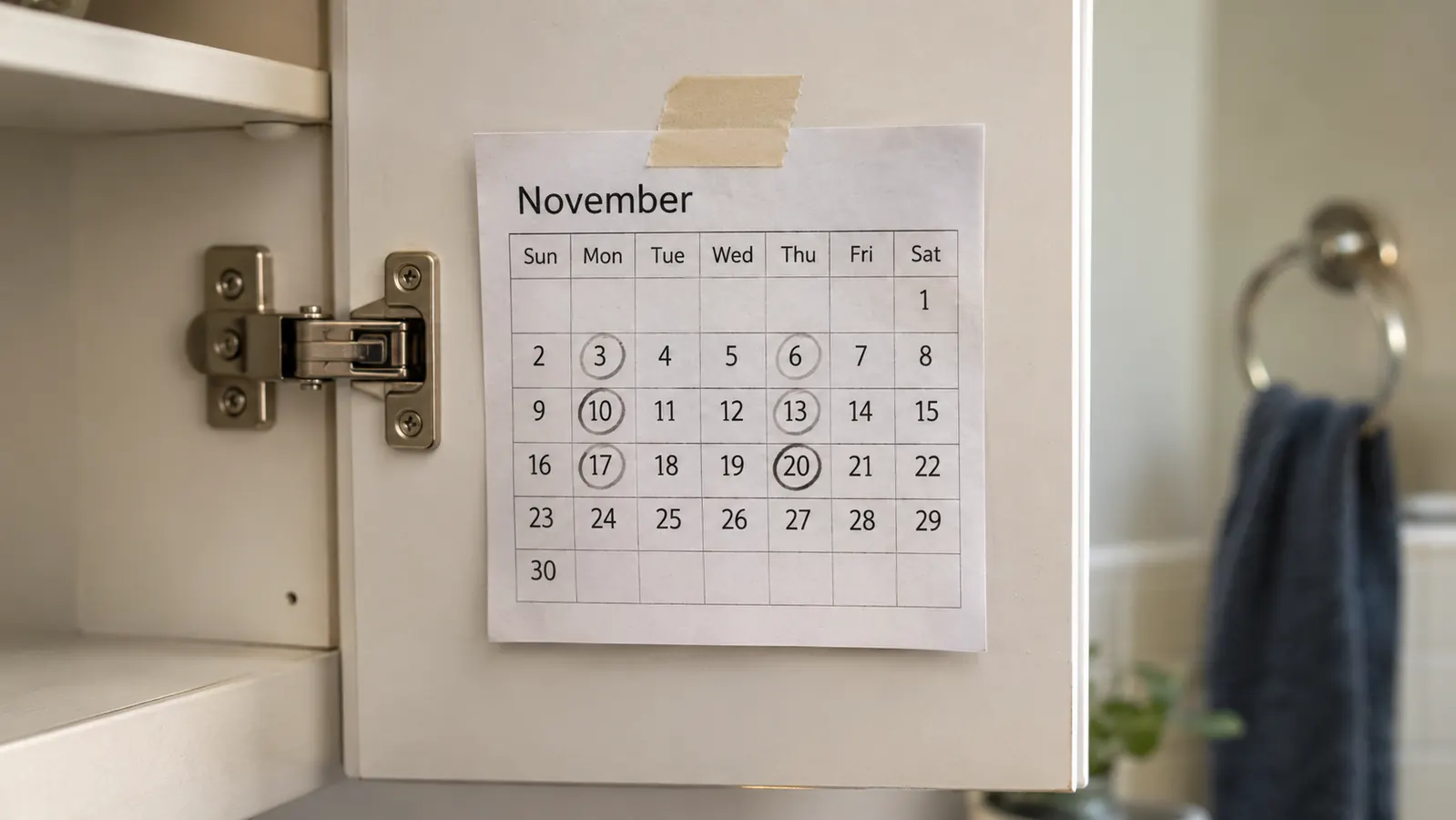
For the first four weeks I used it two nights a week, Tuesday and Friday, and I wrote the dates on a scrap of paper taped inside the medicine cabinet door. Night only, because retinol and daylight do not mix. A thin layer on my face, avoiding my eyes and my lips completely, and then I waited for it to absorb before the eye cream and the moisturizer went on. Thin means thin. If your face is still wet and shiny when you finish, you used too much and you will find out in about ten days.
The order matters and I got it wrong the first night. Cleanser, retinol, wait, eye cream, moisturizer. Nothing else at night. No vitamin C at night and no sunscreen at night. My vitamin C goes on in the morning and the two of them never share a sink.
Two nights a week feels like nothing. That is exactly the point. Almost everybody I know who quit retinol quit because they started at five nights and their face caught fire in week two. You cannot speed up the adjustment by using more of it. You can only slow it down.
Step 4: Expect flaking in weeks two and three, and do not add anything
Around the middle of March, in the second and third week, the skin right beside my nose started flaking. Not my whole face, not redness, just a small patch on each side, the sort of flaking that shows up under a powder foundation and nowhere else. It did not burn. It lasted about ten days and then it stopped, and it has not come back since.
Here is what I did about it, which is to say almost nothing. I kept the moisturizer on, I kept the schedule at two nights a week, and I did not add a scrub to get the flakes off. Flaking skin plus a scrub is a worse week than flaking skin. If your face is burning rather than flaking, that is a different situation, and you should stop using the product and call a dermatologist. I am not one and nothing here is medical advice.
This is the week most people decide the product does not work for them. The flaking is not a sign that it is working and it is not a sign that it is failing. It is an adjustment. It passes if you leave it alone and it gets worse if you fight it.
Step 5: Move to every other night when your skin stops complaining
In April, once the flaking had been gone for a couple of weeks, I went to every other night. That is where I have stayed, eight months later. I have never used it every night and I do not intend to. Every other night is enough for me to see a difference without living in a permanent state of recovering from it.
The change is slow and it is small. By about June, three months in, my skin felt smoother to the touch. My fine lines look a little softer. Not gone. Softer. If you are waiting for the morning the mirror hands you a different face, you will wait a long time and you will quit something that was quietly helping. I noticed nothing at all in April. Nothing.
Patience is the actual ingredient here. I have read about people seeing results in two weeks and I do not know a single person my age who has. What I got was a slow, boring improvement that I only noticed because I had written the start date on a scrap of paper. If I had been judging it week to week, I would have thrown it out in April and told everyone retinol does not work.
The one part that is not optional is the sunscreen. Every morning, rain or shine, Spokane winter included. I have worn it every single day since February and I still cannot point at a visible result, because that is how sunscreen works. You do not see it. You just do not see the damage you would have collected without it, and that is not a thing anybody can photograph.
What Else Helps
The retinol is one product on a shelf with four others and I would be lying if I told you it did the job alone. The moisturizer I started in February is what stopped my cheeks feeling tight, and it did that within about two weeks, before the retinol was even in the house. That was the first change I noticed from anything all year. If your skin is dry, fix the dry first. A retinol on top of dry skin is a fight you arranged for yourself.
The vitamin C I added in April goes on in the morning on clean skin before everything else, and it is the product I credit for the age spot on my left cheek looking a little lighter by late June. It did not go away. It looks lighter. The eye cream I started in May is the only thing I put near my eyes, and it made the under-eye skin feel less dry within a few weeks. My dark circles look about the same and I have made my peace with that.
Two last things. Keep your start date somewhere you will see it, because three months is longer than it sounds and you will want the proof when you are tempted to quit in week five. And if anything on your face looks like a rash, a burn, a patch that bleeds, or a spot that changes shape, that is a dermatologist appointment and not a product decision. I see mine once a year and I would rather make that call than guess from a listing photo.
By about June, three months in, my skin felt smoother to the touch. My fine lines look a little softer. Not gone. Softer.
That is the whole routine. CeraVe at night on the nights that are retinol nights, a plain cleanser, a moisturizer that solved the dryness, a vitamin C in the morning, and sunscreen on top of all of it every single day. Five products, one shelf in the upstairs bathroom, about four minutes. Nobody is going to mistake me for 40. I just wanted my skin to feel like mine again, and eight months in, it does.
The slow version is the one still going in March
CeraVe Resurfacing Retinol Serum, one ounce, night only, two nights a week to start and every other night once your skin settles. If a retinol has burned you before, this is a reasonable place to try again, slower.
Amazon Check Today's Price on Amazon →