

For a year I did what I suspect you are doing right now. I ran my face lotion up under my eyes and called it an eye cream. Then a close-up photo from my sister Patty's birthday dinner in January showed me exactly what that had accomplished. The skin under my eyes looked thin and dry and tired, and every bit of it showed under the restaurant lights. I am 59 years old. I am not trying to look 35 and I am not trying to erase anything. I just wanted the under-eye area to stop looking like crepe paper by four in the afternoon.
What I found out is that the cream matters less than most of us think, and the way you put it on matters more. I have used Clinique All About Eyes since the first week of May, morning and night, and the honest truth is that for the first three weeks I was doing it wrong. Too much product, too much dragging, placed too close to the lash line. What follows is the version I use now, one step at a time, in the order I actually do it. This is what works for my dry, mildly sensitive 59-year-old skin. If something looks like a rash, a growth or a change, that is a dermatologist's call and not a cream's.
The one I use twice a day, applied with a ring finger and a pea
Clinique All About Eyes in the 0.5 ounce mini jar. Fragrance free, allergy tested, ophthalmologist tested. It softened the dry under-eye feel for me and did nothing for my dark circles, which you should know before you buy.
Amazon Check Today's Price on Amazon →Step 1: Start With a Clean, Dry Face, and Get the Order Right
Wash first, then pat dry and wait a minute. Not dripping, not damp. Cream applied to a wet face slides around and dilutes, and you end up using more to compensate for it. I use a plain gentle drugstore cleanser, morning and night, the kind with no brand worth mentioning, and I have used the same one for years.
Before this, my morning was one step. Cleanser, then a face lotion, then out the door. I put that lotion on while my face was still damp because I had read somewhere that damp skin holds moisture better, and for a while I thought that was the trick. It was not. On damp skin the lotion slid up under my eye and kept sliding, and by the time I reached the car it had pooled in the inner corner and my eyes were watering. The first week I tried to fix it by using less, which just left the under-eye dry again by noon. The actual fix was drying my face properly first, then putting a separate small amount under each eye. Two changes, one week, and the watering stopped.
The order is the other part people skip. Mine in the morning: cleanser, then the vitamin C serum, then the eye cream, then face cream, then sunscreen last. At night: cleanser, then the retinol serum on the nights I use it, a couple of minutes for it to sink in, then the eye cream, then face cream. No vitamin C at night. No sunscreen at night. Retinol is a night job and vitamin C is a morning job, and I never put them on at the same time of day.
Two reasons the eye cream sits where it sits. It goes on before the heavier face cream so it touches the under-eye skin directly instead of trying to work through a layer of something else. And it goes on after the retinol has absorbed, because retinol does not go anywhere near my eyes. Only the eye cream goes near my eyes. That is the one rule I do not bend, and it is the first thing I would hand to anyone starting out.
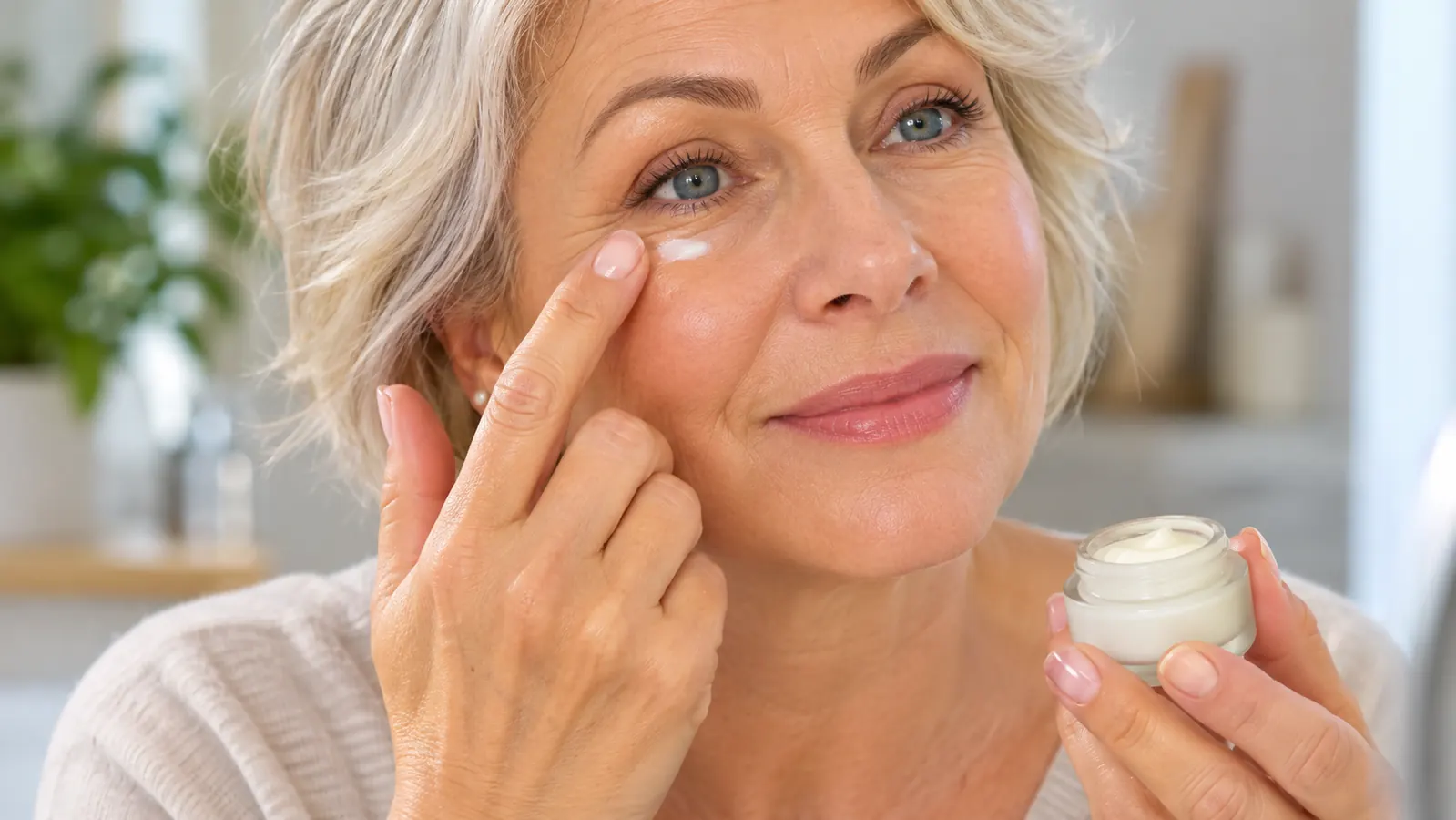
Step 2: Take One Pea for Both Eyes
A pea. One pea, split between two eyes. I put a small dot on the tip of my ring finger, touch it under one eye, then use whatever is left on the other one. That is the dose, morning and night, and it has not changed since about the second month.
The first month I used about three times that, because a pea felt like nothing. It is not nothing. Extra cream does not absorb, it sits on top, then it migrates, then your eyes water for an hour and you decide the product is too strong for you. The jar is 0.5 ounce, the mini travel size, and a correct dose makes it last a good deal longer than the size suggests.
Here is the morning that taught me. Early June, a nine o'clock dentist appointment of my own, not a patient's, and I was running behind. I took what I thought was a pea and it was closer to a small grape. By the time I reached the parking lot my eyes were streaming and my mascara was gone, and the woman at the front desk asked me twice if I was all right. I went home and read the box again, which says to apply sparingly, and it says that for a reason. Since then the dot goes on the finger first and I look at it before it goes anywhere near my face.
If a pea feels stingy, the fix is not more cream. The fix is more patting. Give it thirty seconds of light taps and it disappears into the skin, and the under-eye area feels soft afterward instead of slick.
Step 3: Ring Finger Only, and Pat Instead of Rubbing
Ring finger. It is the weakest finger on your hand and it cannot press hard, which is exactly what you want under an eye. Not the index finger, not an applicator, not the pad of your thumb. The ring finger, every time, until it becomes automatic and you stop thinking about it.
Then pat. Do not rub, do not sweep, do not drag outward in one long stroke the way they do in the videos. Little taps, starting at the inner corner and working out, maybe eight or ten of them under each eye. Then take whatever is left on the finger and tap it along the brow bone above. Thirty seconds for both eyes, that is the whole job.
For about two weeks in May I did the sweeping thing instead, one long stroke from the inner corner out toward the temple, because it felt efficient and it looked like something I had seen somewhere. By the end of that stretch the skin under my right eye looked red and felt raw, and I honestly could not tell whether it was the cream or me. I stopped for four days, went back with the tapping instead, and the redness did not return. That is how I know it was the dragging. If you are going to change one habit at a time, change that one first, because it costs nothing and it is the likeliest culprit.
I also stopped rubbing my eyes when I am tired, which was harder than it sounds. If you wear contacts and you are in and out of them all day, this is the step worth paying attention to.
The under-eye skin felt less dry within a few weeks. The crepey lines look about the same, and the dark circles look about the same. I would rather tell you that than sell you something.

Step 4: Stay on the Bone, Not in the Lashes
The cream goes along the orbital bone, roughly a finger-width below the lash line. Not up in the lashes, not on the lid, not in the corner where the tears drain. Then the leftover goes on the brow bone. That is the whole map and it takes about four seconds to learn.
Cream placed too close to the lash line migrates into the eye within a few minutes. Then it stings, your eyes water, and you conclude the product is bad. I have done this more than once. It is operator error, not a formula problem, and the fix is backing the placement off by half an inch.
I skip the lid entirely. My lids are not dry, and I do not want anything sitting there doing nothing. If your lids are dry, that is a question for your own counter or your own dermatologist, not for me.
Step 5: Twice a Day, and Give It Weeks Before You Judge It
Morning and night, which is what the package says to do. Not once when I remember. The jar lives on the top shelf of the medicine cabinet in the upstairs bathroom, which is the only place it lives, and it is the third thing I reach for in the morning after the cleanser and the vitamin C.
Now the honest part, about six months in. The under-eye skin felt less dry within a few weeks, and that is the change that has held. Morning puffiness looks a little better. The crepey lines look about the same as they did in May. My dark circles look about the same, and the listing does say dark circle reducing, so take that for what it is worth. I would rather tell you that than sell you something.
Give any eye cream four to six weeks before you form an opinion, and take a photo once a month in the same window light. I keep those photos in a folder on my phone, taken at about seven in the morning in the bathroom window before I put anything on my face. Six pictures in there now. Same window, same light, same unimpressed expression. When I line them up side by side I can see the dry patch under my left eye settle down between May and June, and I can see everything else stay more or less where it was. Without the photos I would have sworn the lines had improved, because that is what hope does when you look in the same mirror every day.
What Else Helps
The cream is one small part of it. What has helped my under-eye area as much as anything is simply not rubbing it. I take my makeup off gently instead of scrubbing, I stopped tugging at the corners when I am tired, and I wear sunglasses on my morning walk. In a Spokane winter the humidifier in the bedroom runs most nights, and dryness shows up under my eyes before it shows up anywhere else.
Sunscreen goes on last every morning, including the cloudy ones, and I bring it up near the eye without putting it in the eye. My old sunscreen stung and I only wore it in summer. The mineral one I use now does not sting, so I actually wear it, and wearing it every day does more for how my skin looks than anything I could add afterward.
The other four products in my routine do different jobs and none of them are eye products. The retinol serum is for texture. The vitamin C is for brightness and the age spot on my left cheek. The face cream is for dryness. The sunscreen is for sun. Only the Clinique eye cream goes near my eyes. When one product starts doing three jobs, that is usually when my skin gets cranky.
Start with the pea, not the jar
One pea for both eyes. Ring finger. Pat along the bone. Morning and night. If the skin under your eyes is dry and crepey, that routine is worth four honest weeks before you decide anything. Clinique All About Eyes in the 0.5 ounce mini is the one on my shelf.
Amazon Check Today's Price on Amazon →